

The mechanics of digital advertising are undergoing a fundamental structural shift. The era of manual bid adjustments, rigid A/B testing schedules, and demographic assumptions has largely ended. Today, the landscape of pay per click advertising is driven by machine learning algorithms that process millions of data points in milliseconds. What was once a discipline defined by human operators pulling levers in a dashboard is now an exercise in training, guiding, and integrating advanced artificial intelligence.
This transition moves performance marketing from a reactive process to a predictive one. Advertisers no longer wait for weekly reports to adjust a struggling campaign. Instead, interconnected AI models analyze user behavior, generate creative variations, adjust bids in real-time, and execute campaign structures autonomously. The introduction of tools like Anthropic’s Claude operating through secure protocols directly within ad platforms demonstrates just how autonomous these systems have become. By examining these technologies, businesses can understand the new baseline required to achieve profitable returns in modern paid acquisition.
Understanding the Evolution of Pay-Per-Click Advertising
Historically, success in pay-per-click advertising relied heavily on manual labor and human intuition. Campaign managers would build massive spreadsheets mapping out thousands of keywords, manually group them into distinct ad groups, and write multiple static text ads for each. Bidding required logging into the platform daily to increase bids on keywords that drove sales and decrease bids on those that drained the budget. Segmentation was equally rigid, relying on broad demographic categories like age, gender, and geographical location.
As advertising networks grew, the volume of data available to marketers expanded beyond human processing capacity. A single search query might carry hundreds of contextual signals—the user’s specific device model, their operating system, the time of day, their past browsing history on partner sites, and their proximity to a physical store. Human operators could not adjust bids for every possible combination of these signals.
The platforms responded by introducing early forms of machine learning, starting with simple automated bidding rules. Over the last decade, this evolved into full algorithmic control. AI became a structural necessity rather than an optional feature. Modern platforms now ingest vast amounts of behavioral data, identify hidden patterns, and execute optimizations at a scale and speed impossible for manual operators. The human role has shifted from executing micro-adjustments to defining the business rules, target costs, and strategic guardrails that the AI must operate within.

Meta’s MCP & Claude Integration: A New Era of Automated Campaign Management
The integration of Large Language Models (LLMs) with advertising platforms marks the latest phase in campaign automation. A prime example of this convergence is the use of Anthropic’s Claude combined with the Model Context Protocol (MCP) to manage campaigns on Meta’s platform. MCP is an open standard that allows AI models to securely connect to external databases, APIs, and tools. When applied to Meta Ads, this protocol bridges the gap between Claude’s advanced reasoning capabilities and the operational mechanics of the ad account.
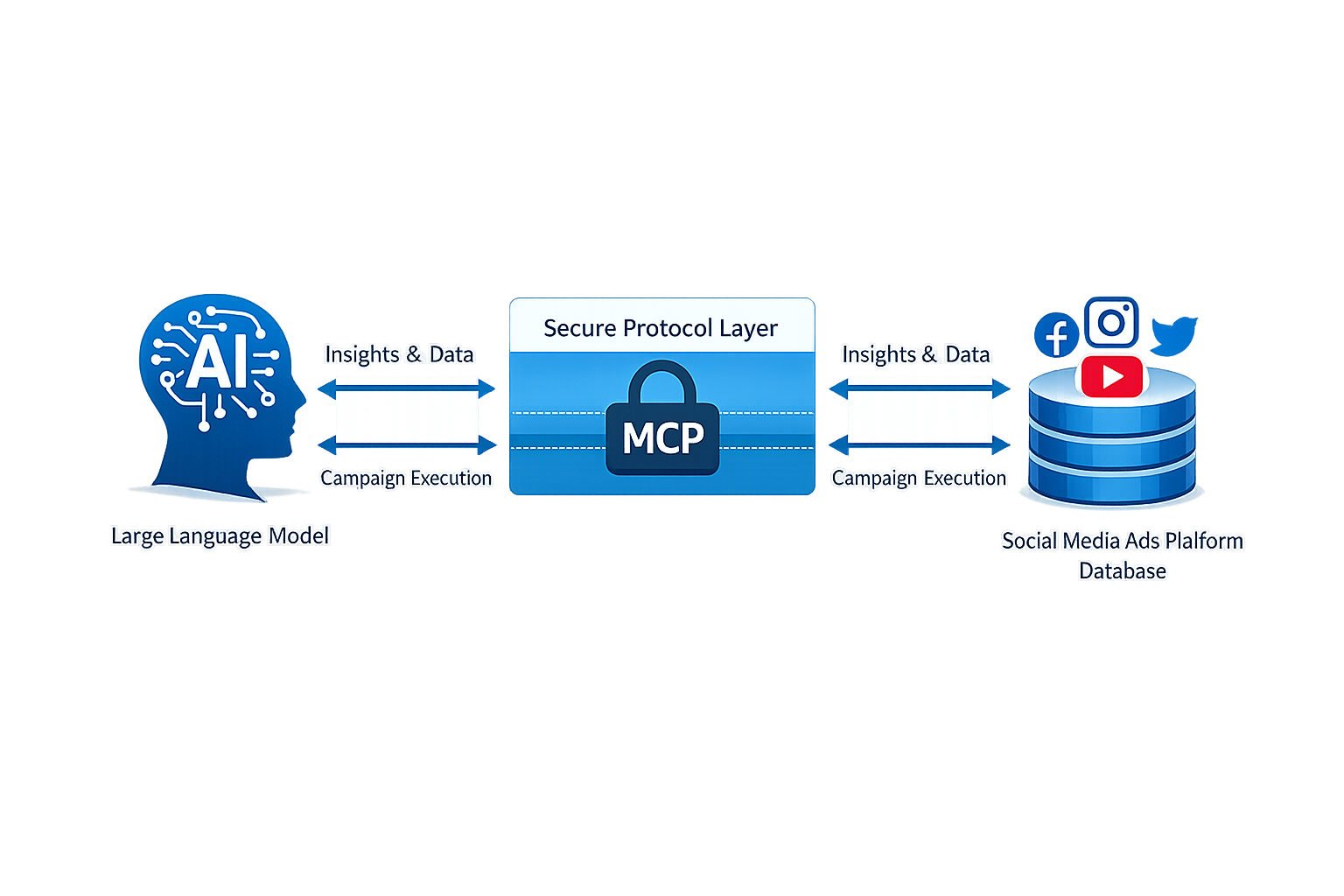
Traditionally, launching or auditing a Meta campaign required a human operator to navigate the Ads Manager interface, analyze historical data, build new audiences, and manually upload creative assets. By utilizing MCP, an agency can connect Claude directly to the Meta Ads API. The AI assistant can query the account’s historical performance, asking the API for data on which ad sets have the highest return on ad spend (ROAS) or which creative formats suffer from the highest fatigue rates over a 30-day period.
Once Claude retrieves and processes this data, it uses its natural language processing capabilities to synthesize a strategy. If the data shows that video ads featuring user-generated content outperform static images for a specific product line, Claude can draft a new campaign structure prioritized around that format. Because of the two-way nature of MCP, Claude does not just offer advice; it can generate the JSON payloads required to instruct the Meta API to build the campaigns, allocate the budgets, and set the targeting parameters.
This integration fundamentally changes how campaign management operates. A media buyer can input a plain-text prompt such as, “Analyze our Q3 lead generation campaigns, identify the lowest cost-per-acquisition audience segments, and build a new Q4 campaign structure allocating 70% of the budget to those segments.” Claude processes the request, pulls the relevant Meta data, designs the campaign hierarchy, and executes the build. This reduces a process that typically takes hours of manual spreadsheet work and data entry into a task completed in minutes. It also ensures optimizations are based on deep data analysis rather than surface-level dashboard metrics, significantly improving the efficiency and performance of the resulting campaigns.
AI-Powered Ad Creative and Copy Generation
The bottleneck in performance marketing has frequently been creative production. Testing multiple angles, value propositions, and visual formats requires significant time and design resources. AI tools have dismantled this bottleneck by generating ad copy, headlines, image variations, and video content at scale.
Modern AI systems employ generative adversarial networks (GANs) and diffusion models to build visual assets. An advertiser can provide a single product photo, and the AI can generate dozens of variations, placing the product in different lifestyle settings, adjusting the lighting, and altering the background to appeal to different audience segments. A single shoe image can be placed on a city street for an urban demographic, or on a hiking trail for an outdoors demographic, without requiring a new photoshoot.

Text generation operates on similar principles. LLMs trained on millions of high-converting ad variants can instantly write hundreds of headlines and primary text options tailored to specific search intents or platform constraints. These systems understand character limits, keyword placement requirements, and the distinct tones required for different platforms—differentiating the professional language needed for LinkedIn from the conversational tone suited for TikTok.
When deployed within dynamic creative optimization (DCO) systems, these AI-generated assets allow for multivariate testing at an unprecedented scale. The ad platform dynamically assembles the ad at the moment of the impression, matching the specific headline, image, and call-to-action that its predictive models determine is most likely to convert the specific user viewing it. This continuous, algorithmic testing rapidly phases out underperforming combinations and funnels the budget into the variations driving actual business results, lowering the cost of acquisition through sheer relevance.
Predictive Analytics and Advanced Audience Segmentation
Standard audience targeting relies on static parameters. Advertisers define the age range, geographic location, and known interests of the people they want to reach. While useful, this approach is fundamentally backward-looking; it targets users based on who they are or what they have done in the past, rather than what they are likely to do in the future.
AI introduces predictive analytics into audience segmentation. Machine learning models analyze the complex sequences of actions users take across the web to calculate propensity scores. A propensity score is the algorithmic probability that a specific user will complete a desired action, such as making a purchase or filling out a lead form, within a specific timeframe. The AI evaluates thousands of micro-signals to arrive at this score. It might recognize that users who read three blog posts, spend more than two minutes on a pricing page, and return to the site via a mobile device 48 hours later have an 85% probability of converting.
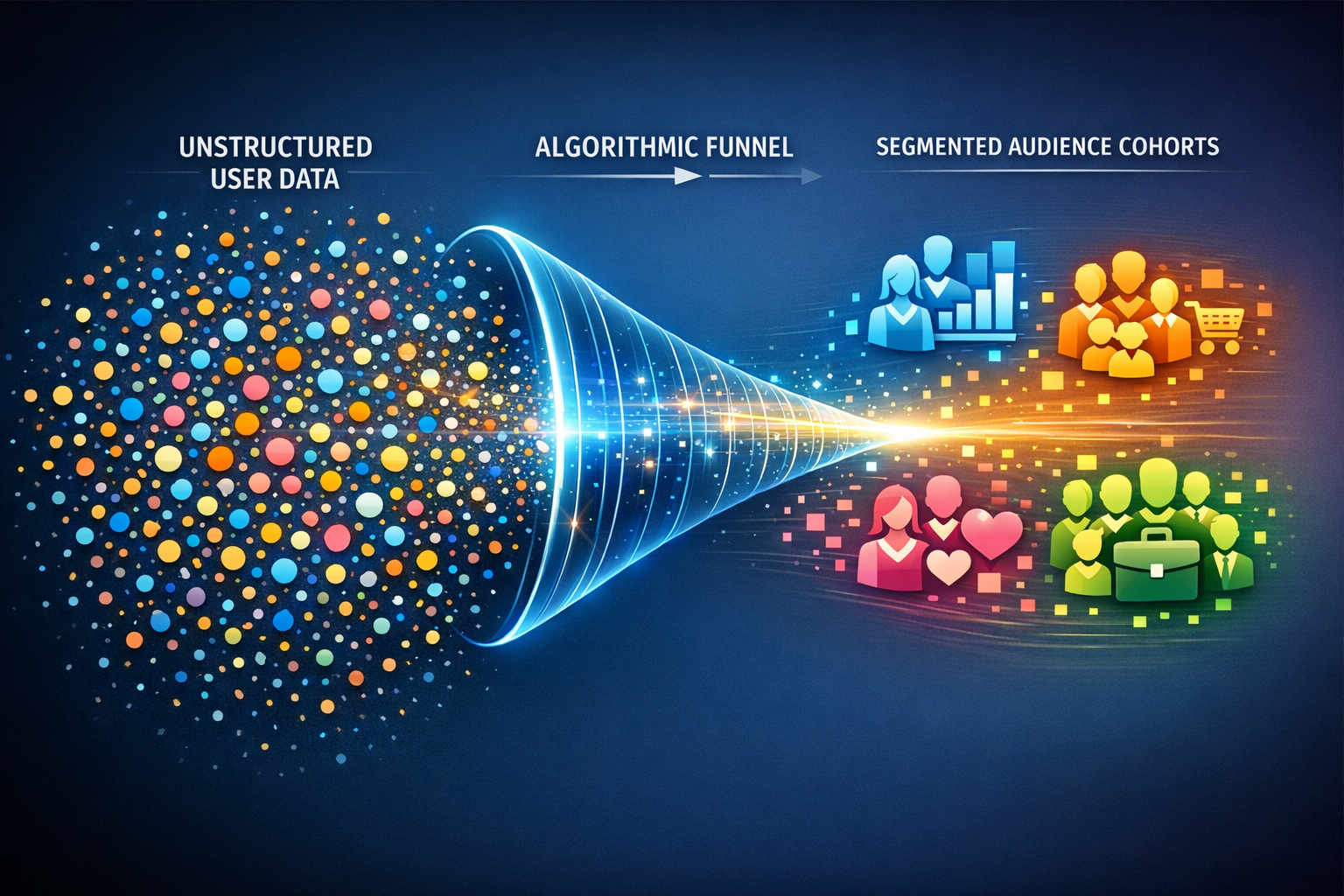
This allows advertisers to move away from broad demographic targeting and instead target high-propensity cohorts. Ad platforms use these predictive models to power advanced lookalike audiences and broad targeting algorithms. Rather than the advertiser telling the platform exactly who to target, the advertiser provides a seed list of high-value customers. The AI analyzes the behavioral patterns of those customers and searches the network for new users exhibiting the exact same complex digital behaviors.
Furthermore, predictive analytics enables value-based targeting. Instead of merely optimizing for the sheer volume of conversions, AI models can predict the potential lifetime value (pLTV) of a user before they even click the ad. The system segments audiences based on their predicted profitability, allowing the advertiser to focus their budget on acquiring customers who are likely to make repeat purchases or sign up for high-tier services, directly improving the long-term return on investment.
Real-Time Bid Optimization and Budget Management
The core of any pay-per-click system is the auction. Every time a user enters a search query or loads a social media feed, an automated auction takes place to determine which advertiser gets the impression and how much they pay for it. In a manual environment, advertisers set fixed bids for keywords or audiences, adjusting them periodically based on historical performance. This method is inherently inefficient because the value of an impression fluctuates wildly depending on the specific context of the user.
AI transforms this process through real-time, auction-time bidding. When an impression becomes available, the ad platform’s machine learning algorithm calculates the expected conversion rate for that specific user at that exact microsecond. It evaluates the user’s device, operating system, physical location, time of day, past interaction with the brand, and current behavior patterns. If the algorithm determines the user has a high probability of converting, it automatically increases the bid to win the auction. If the user’s context suggests a low probability of conversion, the system lowers the bid or drops out of the auction entirely to conserve budget.
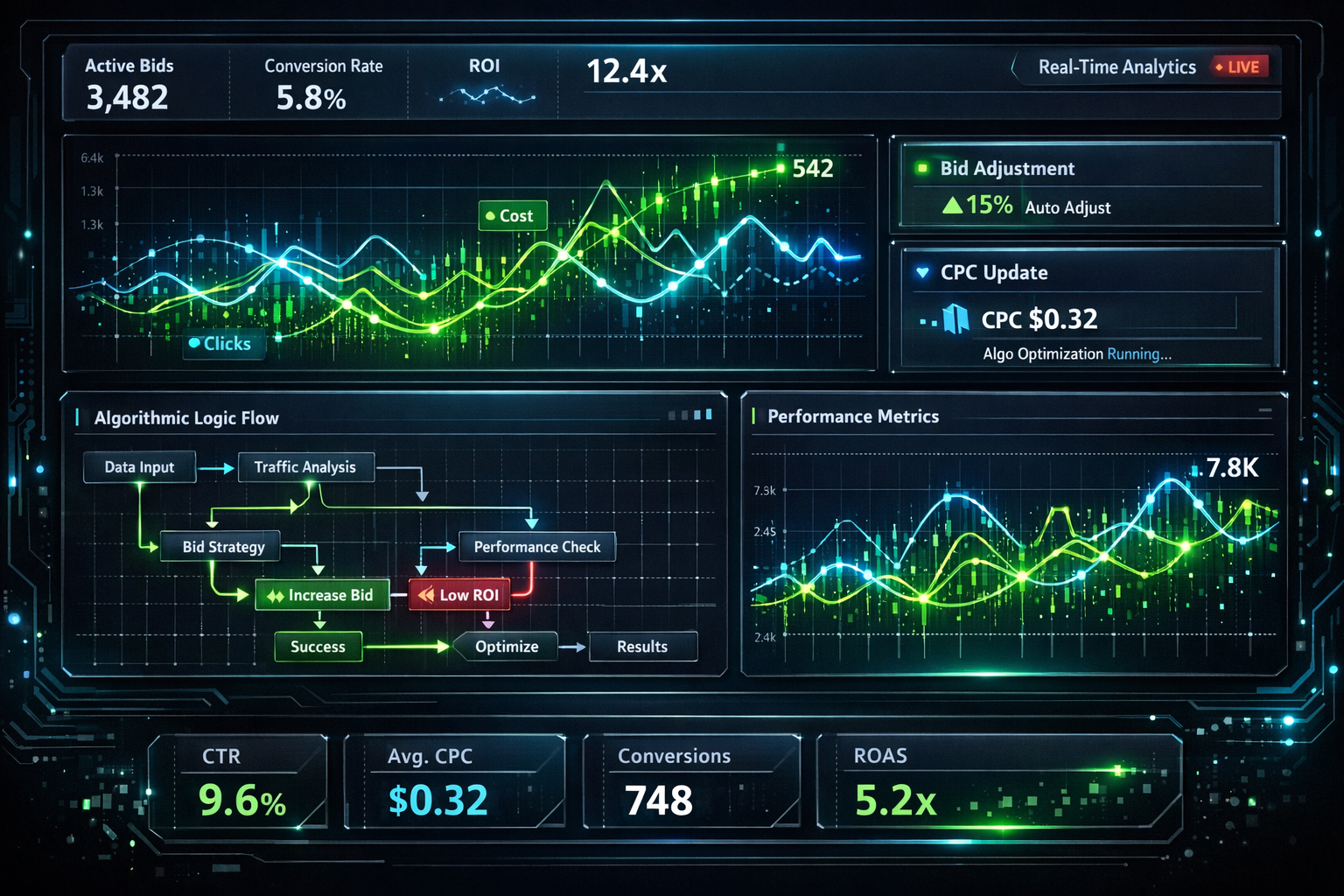
This dynamic bidding occurs millions of times per day, optimizing every single cent of the daily budget. Beyond individual bids, AI also manages budget liquidity across different campaigns and channels. Machine learning models continuously monitor the marginal cost of acquisition across all active campaigns. If the algorithm detects that the cost per lead is currently lower in a remarketing campaign than in a cold-traffic search campaign, it will fluidly shift budget into the more efficient channel in real-time. For businesses optimizing PPC services, this automated budget allocation eliminates the wasted spend that occurs when fixed budgets remain trapped in underperforming campaigns while highly profitable campaigns exhaust their daily limits.
AI-Driven Performance Measurement and Attribution
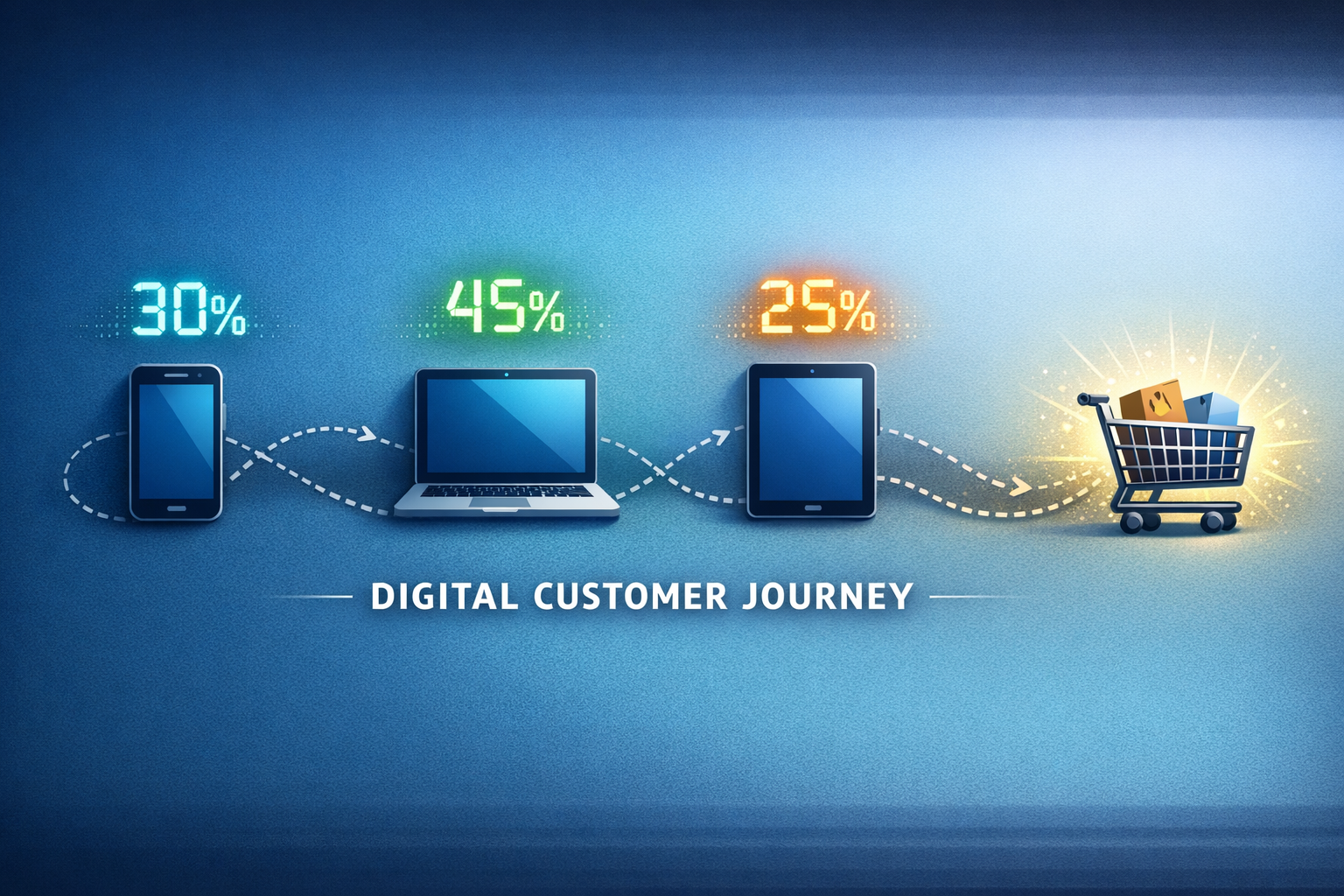
Measuring the true impact of advertising has become increasingly difficult. Customer journeys are rarely linear; a user might discover a brand on their phone through a social media ad, conduct research on a work laptop via organic search days later, and finally click a branded search ad on their tablet to make a purchase. Traditional last-click attribution models assign 100% of the credit to that final search ad, completely ignoring the social ad that introduced the brand and generated the initial demand.
Additionally, privacy regulations and the deprecation of third-party cookies have created severe signal loss. Browsers and operating systems increasingly block the tracking mechanisms that historically allowed advertisers to connect ad views to website conversions.
AI addresses these measurement challenges through data-driven attribution (DDA) and marketing mix modeling (MMM). Data-driven attribution uses statistical algorithms to analyze both converting and non-converting paths. By comparing the sequences of touchpoints, the AI calculates the actual incremental contribution of each specific ad interaction. It might determine that the initial social video ad increased the probability of conversion by 40%, the organic search by 20%, and the final search ad by 40%, distributing the credit accordingly.
To combat signal loss, platforms use machine learning for conversion modeling. When a user’s exact path cannot be tracked due to privacy restrictions, the AI analyzes aggregate data from users who share similar characteristics and whose paths were tracked. It uses this deterministic data to build probabilistic models, accurately estimating the number of conversions that occurred but were hidden by privacy settings. This provides advertisers with a complete, accurate picture of campaign performance, ensuring that budget decisions are based on the full impact of the advertising ecosystem rather than a fragmented, last-click view.
The Future of PPC: AI as a Strategic Partner
The rapid integration of generative AI, predictive analytics, and automated bidding algorithms has fundamentally rewritten the rules of paid acquisition. AI is no longer just a feature within a platform; it is the engine powering the entire ecosystem. From generating the visual assets to predicting user behavior and executing split-second auction strategies, machine learning handles the operational heavy lifting of campaign management.
For agencies and brands engaged in performance marketing, this shift requires a new operational model. The value of a media buyer is no longer tied to their ability to manually adjust bids or build complex spreadsheet formulas. Instead, value is derived from strategic direction. Marketers must focus on supplying the AI with high-quality first-party data, designing rigorous testing frameworks, defining accurate business objectives, and crafting compelling brand narratives that the AI can distribute.
The machines have mastered the execution of the tactics. The advertisers who succeed in this new environment will be those who master the strategy, using AI not merely as an automation tool, but as a strategic partner to scale their business.
Frequently Asked Questions
What is an example of PPC automation?
AI-powered bidding strategies, such as Target CPA (Cost Per Acquisition) and Maximize Conversions, are common examples of PPC automation. Other examples include dynamic creative optimization where platforms automatically test various combinations of text and images, and automated audience expansion algorithms that identify new user segments similar to your existing converting customers.
Which is better, CPM or CPC?
Neither model is inherently better; the optimal choice depends entirely on the specific campaign goals. CPC (Cost Per Click) is generally the standard for direct-response campaigns aiming to drive website traffic and conversions, as the advertiser only pays when a user actively engages. CPM (Cost Per Mille, or thousand impressions) is typically used for brand awareness campaigns where the goal is maximum visibility and reach rather than immediate clicks. Modern AI bidding systems can optimize campaigns efficiently under either model based on the stated objective.
What is the 3-3-3 rule in marketing?
The 3-3-3 rule is a traditional, simplified testing framework for paid advertising. It generally involves creating three distinct ad variations (testing different headlines, copy, and images) and running them across three different ad sets or campaigns for a period of three days to gather initial performance data. While this rule provided a structured way for humans to test variables, modern AI-driven platforms can execute multivariate testing at a vastly larger scale, testing hundreds of variations simultaneously over longer periods to generate statistically significant data.