
PPC works very well for Toronto small businesses. The problem is that most of the advice written about it was written by agencies whose smallest client spends $20,000 a month on ads. That’s not your situation.
A small business running $1,500 to $3,000 a month in paid advertising in Toronto is playing a different game. The margin for error is smaller, the competition is real, and the budget doesn’t leave much room for the kind of trial and error that larger accounts can absorb.
The businesses that make PPC work at this scale aren’t doing anything complicated. They’re doing a small number of things correctly and not wasting money on everything else. This post covers what those things are, what to skip, and how to figure out whether PPC makes sense for your business right now.
Why PPC is harder for Toronto small businesses than most agencies admit
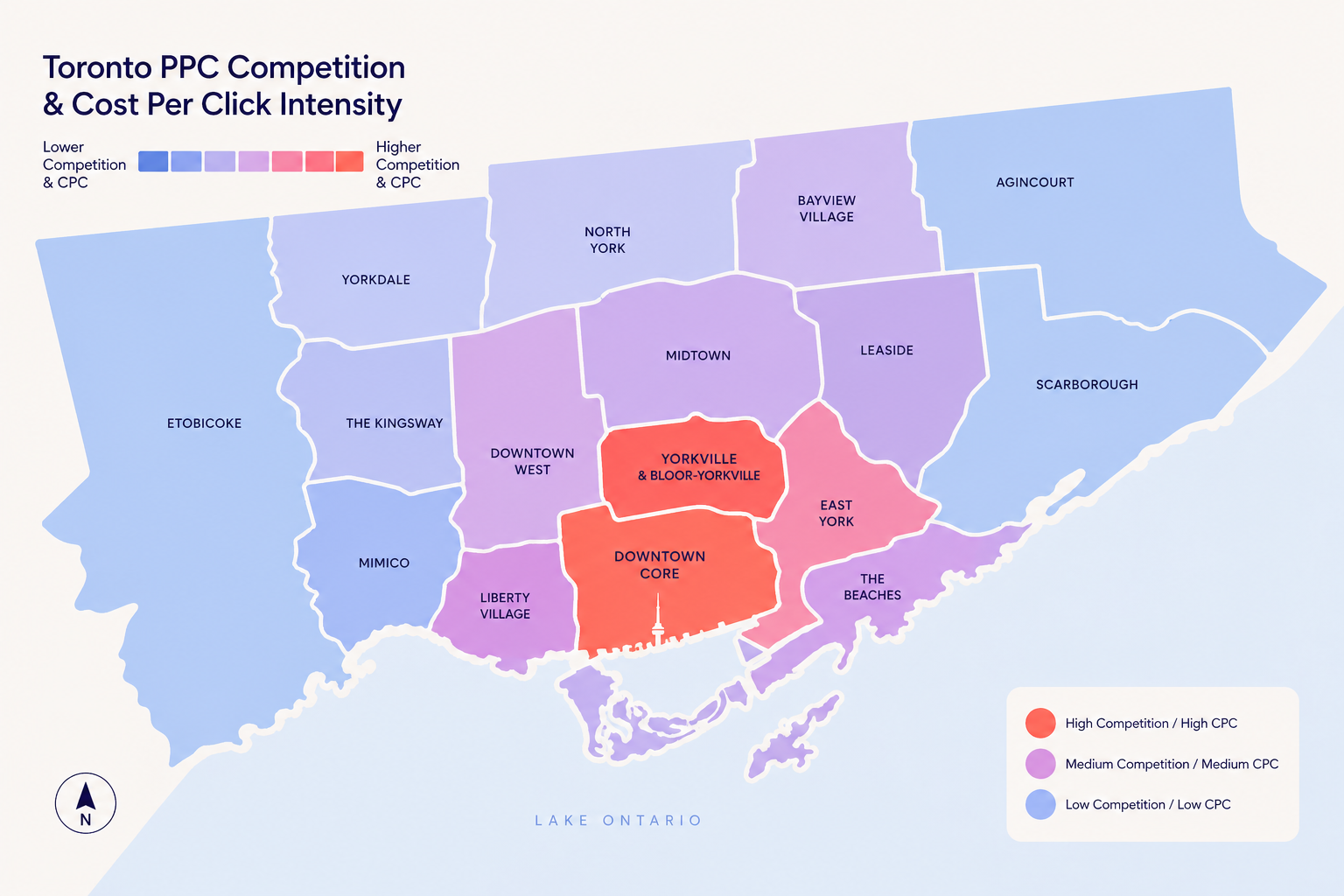
Toronto is the most competitive paid search market in Canada. That’s not an opinion, it shows up directly in what you pay per click.
A plumber in Sudbury might pay $8 to $12 CAD per click on Google Ads. The same keyword in Toronto runs $25 to $45. A personal injury lawyer in a mid-sized Ontario city might pay $40 per click. In Toronto that number can exceed $150. Real estate, finance, home services, legal, and healthcare all follow the same pattern. The concentration of businesses competing for the same searches in the GTA drives costs up in a way that simply doesn’t exist in smaller markets.
This matters for small businesses because your cost per conversion is directly tied to your cost per click. If you’re paying $30 per click and your landing page converts at three percent, your cost per lead is $1,000. That math only works if your average sale is significant enough to absorb it.
The big brand problem
Small businesses in Toronto also compete against national brands with substantially larger budgets and higher quality scores built up over years of account history. Google’s auction system rewards accounts with strong historical performance data. A brand that has been running Google Ads for five years with a well-optimised account will pay less per click for the same keyword than a new account just getting started.
This doesn’t mean PPC doesn’t work for Toronto small businesses. It means you need a smarter approach than just setting a budget and picking keywords. Competing on broad high-volume terms against established brands is a fast way to burn through a small budget with nothing to show for it. Competing on tightly targeted, high-intent searches in specific neighbourhoods and niches is a different story entirely.
What actually works for Toronto small businesses
The small businesses that get real results from PPC in Toronto share a few consistent habits. None of them are complicated. Most of them are just the opposite of what bad campaigns do.
Go narrow on geography
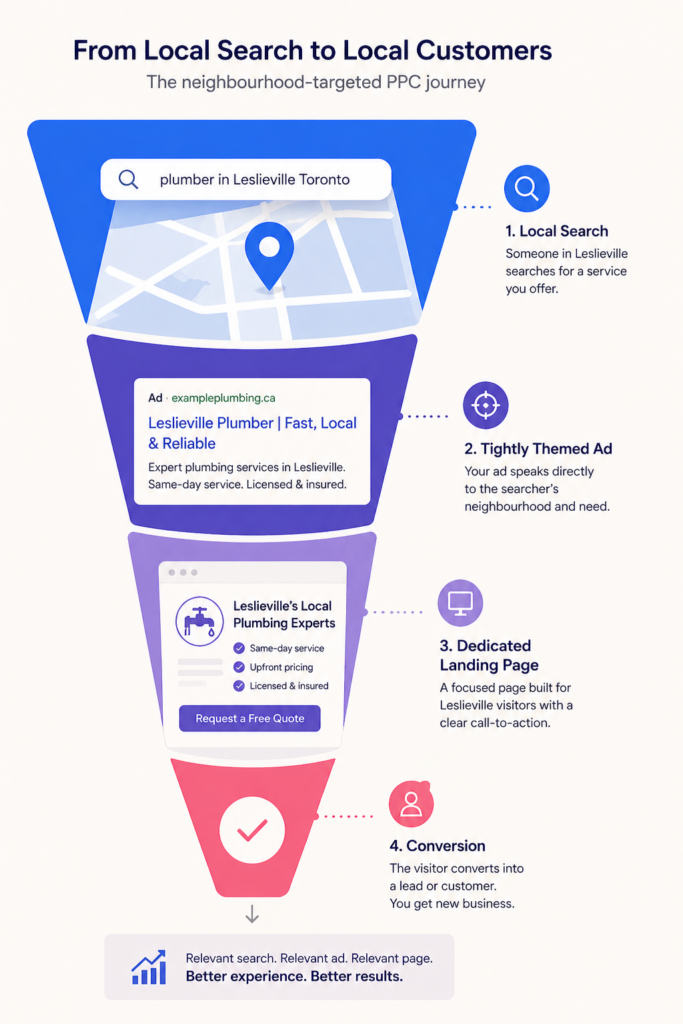
Toronto is not one market. Leslieville searches differently than Etobicoke. A home services business based in Scarborough doesn’t need to pay for clicks from someone in Mississauga they can’t service anyway. Tightening your location targeting to the specific neighbourhoods and postal codes where your actual customers live and work immediately improves the relevance of your ads and cuts the volume of wasted spend.
Most small business campaigns start with the entire GTA selected because it feels like more opportunity. It usually isn’t. A smaller, more relevant audience almost always produces a better cost per conversion than a broad one.
Target keywords with buying intent, not research intent
There’s a big difference between someone searching “what is pay per click advertising” and someone searching “toronto ppc agency pricing.” The first person is curious. The second is close to making a decision.
Small budgets need to be concentrated on the second type of search. Keywords that signal the person is ready to buy, book, or contact someone. Words like “near me,” “cost,” “hire,” “best,” “toronto,” and specific service names attached to location terms all tend to indicate higher buying intent than generic informational queries.
Keep your ad groups tight
One of the most common small business PPC mistakes is dumping twenty keywords into one ad group and writing two generic ads to cover all of them. It produces low quality scores, mediocre click through rates, and ads that feel irrelevant to the person who sees them.
A better approach is small, tightly themed ad groups where every keyword is closely related and every ad speaks directly to that specific search. More setup work upfront, significantly better performance over time.
Send traffic to a dedicated landing page
Your homepage is not a landing page. It has navigation, multiple calls to action, information about every service you offer, and a dozen reasons for someone to click away without contacting you.
A dedicated landing page has one job: convert the person who clicked your ad. It matches the specific promise the ad made, removes distractions, and makes it easy to take the next step. For most Toronto small businesses this is the single biggest lever for improving PPC results without increasing budget.
Start with Google Search before anything else
Google Search targets people who are actively looking for what you sell right now. Meta Ads, display advertising, and YouTube reach people who might be interested. For a small business with a limited budget, starting where buying intent is highest almost always makes more sense than spreading spend across multiple platforms.
Once your Google Search campaigns are profitable and you understand your cost per conversion, then it makes sense to explore other channels. Not before.
What doesn’t work for Toronto small businesses
Most failed PPC campaigns fail for the same reasons. Here’s what to avoid before you spend anything.
Broad match keywords on a small budget
Broad match tells Google to show your ad for any search it thinks is related to your keyword. In theory this expands your reach. In practice it means a plumber in North York pays for clicks from people searching “how to fix a leaky tap themselves” or “plumbing school toronto.” Neither of those people is calling you.
Broad match works on large accounts with enough budget to absorb irrelevant traffic while the algorithm learns. On a small budget it drains spend in the first week and produces a cost per conversion that makes the whole channel look like it doesn’t work. Start with exact match and phrase match, and only expand once you have data showing which searches actually convert.
Competing on high volume generic terms
Keywords like “toronto plumber,” “toronto lawyer,” or “toronto dentist” have high search volume and very high cost per click. They’re also dominated by businesses with large budgets, strong account history, and dedicated landing pages built specifically for those terms.
A small business trying to compete on these terms head-to-head will spend a lot of money for a small share of clicks. A better approach is to go one level deeper. “Emergency plumber north york,” “employment lawyer etobicoke,” “family dentist leslieville” are more specific, less competitive, and searched by people with clearer intent.
Sending paid traffic to your homepage
This comes up in almost every account audit. Someone has been running Google Ads for three months, spending real money, sending every click to their homepage, and wondering why nobody is converting.
The homepage serves a different purpose than a landing page. It’s designed for people who already know your brand and want to explore. A paid click comes from someone with a specific need who clicked a specific ad. If the page they land on doesn’t immediately confirm they’re in the right place and make it easy to take action, most of them leave.
Setting up a campaign and leaving it alone
Google Ads is not a vending machine. You don’t put money in and get leads out without touching it. Search behaviour changes, competitors adjust their bids, keywords that converted last month stop converting this month, and new search terms appear in your account that you’ve never seen before.
A campaign that nobody is actively managing slowly gets worse. Quality scores drift down, irrelevant searches accumulate in the search term report, and cost per conversion creeps up. The businesses that get long-term results from PPC treat it as an active channel that requires regular attention, not a passive one that runs in the background.
Expecting results in the first two weeks
New Google Ads campaigns go through a learning phase where the algorithm is figuring out who to show your ads to and when. During this period, performance is often worse than it will be once the campaign has enough data to optimise properly.
Small businesses that judge PPC in the first two weeks almost always conclude it doesn’t work, pause the campaign, and walk away before it had a real chance. A realistic evaluation period is 60 to 90 days, with active optimisation happening throughout.
How much budget does a Toronto small business actually need
This is the question every small business asks before starting PPC and rarely gets an honest answer to.
Most agencies will tell you to “start with whatever you’re comfortable with” because they don’t want to lose the business. That’s not helpful. Running $500 a month on Google Ads in Toronto is unlikely to produce meaningful results in most industries, and the money spent learning that lesson is wasted.
The minimum viable budget for most industries
For the majority of Toronto small businesses, $1,500 to $2,000 CAD per month in ad spend is the minimum that gives you enough data to optimise properly and enough volume to evaluate whether the channel is working.
Below that threshold, you’re not generating enough clicks to reach statistical significance on what’s converting. You can’t tell whether a keyword is genuinely underperforming or whether it just hasn’t had enough impressions to judge. You end up making decisions based on too little information, which usually means making the wrong ones.
Industry changes the number significantly
A Toronto bakery selling $15 cakes needs a very different cost per conversion than a Toronto law firm billing $300 an hour. The minimum viable budget is tied directly to what a conversion is worth to your business.
A rough rule of thumb: if your average customer is worth $500 or more to your business, PPC in Toronto is worth testing seriously. If your average transaction is $50 and your cost per click is $15, the math is very hard to make work regardless of how well the campaign is managed.
Home services, legal, finance, healthcare, B2B services, and real estate all tend to have economics that support PPC investment at reasonable budgets. Retail, food service, and low-margin consumer products are harder unless you’re running high volume or have strong repeat purchase rates.
Budget for management on top of ad spend
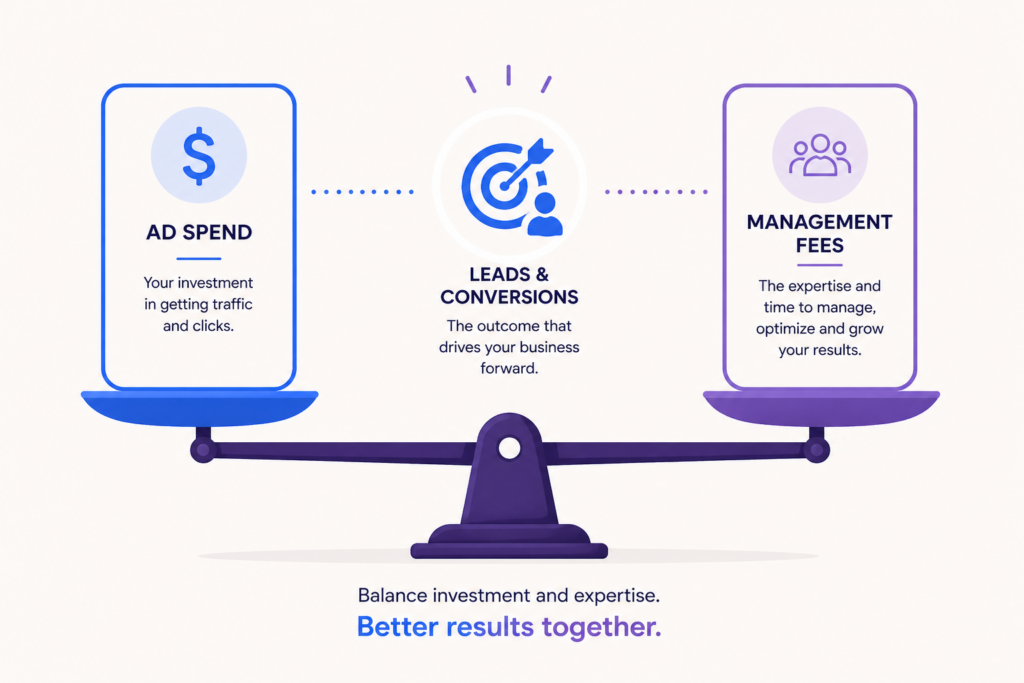
Ad spend is what you pay Google or Meta. Management fees are what you pay a Toronto PPC agency to run the campaigns. These are two separate costs and both need to be factored into your budget planning.
If you’re spending $2,000 per month on ads and paying an agency $1,000 to manage them, your total monthly investment is $3,000. The question is whether the leads or sales generated from that $2,000 in ad spend justify the total $3,000 outlay. A good agency will help you model that before you start, not after you’ve already spent three months finding out.
The platforms that work best for small businesses in Toronto
Not all paid advertising platforms are equal for a small business with a limited budget. Here’s where to focus and why.
Google Search. Start here
For most Toronto small businesses, Google Search is the right first platform. The reason is simple. People searching on Google are telling you exactly what they want right now. Someone typing “emergency hvac repair north york” is not browsing. They have a problem and they need someone to fix it today.
That buying intent is what makes Google Search the most direct path from ad spend to revenue for service businesses, B2B companies, and anyone whose customers search for what they sell before buying it. The cost per click is higher than other platforms but the intent behind each click is also higher, which is why conversion rates on Google Search tend to beat display and social advertising for most small business categories.
Meta Ads. Useful but different
Facebook and Instagram ads reach people who are not actively searching for what you sell. They’re scrolling through a feed and your ad appears in front of them based on demographic and interest targeting. This means the intent behind a Meta click is lower than a Google Search click, and your landing page needs to work harder to convert someone who wasn’t already looking for you.
For Toronto small businesses, Meta Ads work well in two specific situations. The first is retargeting, showing ads to people who have already visited your website but didn’t convert. These people already know who you are, which closes the intent gap significantly. The second is awareness for businesses with a visual product or a strong offer that works well as a social ad, think restaurants, retail, events, and consumer services.
Meta Ads as a primary lead generation channel on a small budget is harder to make work than most agencies suggest. As a secondary channel supporting a Google Search campaign, it can add real value.
Google Display and YouTube. Save these for later
Display advertising and YouTube pre-roll reach large audiences at low cost per impression. They also have low intent and low conversion rates for most small business categories. For a business with a limited budget trying to generate leads or sales, spending on display or YouTube before your Search campaigns are profitable is usually the wrong order of operations.
Once your Google Search campaigns are consistently producing leads at a cost that works for your business, adding display retargeting to stay in front of people who visited your site is a reasonable next step. Starting there before Search is working is putting the cart before the horse.
LinkedIn Ads. Only for specific B2B situations
LinkedIn is expensive. Cost per click routinely runs $8 to $15 CAD even for relatively uncompetitive targeting. For most Toronto small businesses that cost is hard to justify.
The exception is B2B businesses selling to a specific professional audience where LinkedIn’s targeting by job title, company size, and industry is genuinely useful. A Toronto agency selling to marketing directors at mid-sized companies, for example, can use LinkedIn to reach exactly that person in a way that Google Search can’t match. Outside of that specific use case, the cost per click makes LinkedIn a poor fit for small business budgets.
What to do before you spend a single dollar
Most small business PPC campaigns fail before they launch because the groundwork wasn’t done. Here’s what needs to be in place before you put any budget into any platform.
Set up conversion tracking properly
This is the most skipped step and the most costly one to skip. Conversion tracking tells you which keywords, ads, and campaigns are generating leads or sales. Without it you’re flying blind. You know how much you spent and how many clicks you got. You have no idea which of those clicks turned into anything.
In Google Ads, conversion tracking needs to be set up before your campaign launches, not after. At minimum you need to track form submissions and phone calls. If you’re running an ecommerce store, purchase tracking is non-negotiable. Setting this up requires adding a small snippet of code to your website, either directly or through Google Tag Manager. If you’re not comfortable doing this yourself, it’s worth paying someone to do it correctly before you spend a dollar on ads.
Review your landing page before sending traffic to it
Before launching any paid advertising, look at the page you’re planning to send traffic to with fresh eyes. Ask yourself whether a stranger who clicked an ad for your specific service would immediately understand they’re in the right place, know what you’re offering, and know exactly what to do next.
If the answer to any of those is no, fix the page first. A $2,000 monthly ad budget sending traffic to a confusing or unconvincing landing page will produce worse results than a $500 budget sending traffic to a page that converts well. The landing page is half the campaign.
Do your keyword research before you build anything
Knowing which keywords to target, which ones to avoid, and what the competitive landscape looks like in your specific Toronto market saves significant budget. You want to know the approximate cost per click for your target keywords before you set a budget. You want to know which search terms your competitors are bidding on. You want a list of negative keywords ready to add on day one so you’re not paying for irrelevant searches from the start.
Free tools like Google Keyword Planner give you enough to start. Paid tools like Semrush give you more detail on competitor activity and search volume. Either way, spending two to three hours on keyword research before launch is some of the highest leverage work you can do for a PPC campaign.
Know your numbers before you start
What is a lead worth to your business? What percentage of leads typically convert to paying customers? What is your average transaction value? These numbers determine whether PPC can work for you at all and what a reasonable cost per conversion looks like.
If you don’t know these numbers, spend time figuring them out before you launch anything. A Toronto PPC agency can help you model the economics of a campaign before you commit to a budget. Any agency worth working with will have that conversation with you upfront rather than just asking for your credit card details and getting started.
When to hire a Toronto PPC agency vs manage it yourself
This is worth addressing honestly because the answer isn’t always “hire an agency.” For some small businesses at certain budget levels, managing PPC yourself makes sense. For others it doesn’t.
When managing it yourself is reasonable
If your monthly ad spend is under $1,500 CAD and you have time to learn the platform properly, managing Google Ads yourself is a legitimate option. Google’s own certification courses are free and cover the fundamentals well enough to run a basic campaign. There are also good paid courses from practitioners who teach small business PPC specifically.
The tradeoff is time. Learning Google Ads well enough to not waste money takes 20 to 30 hours upfront. Managing a campaign properly takes three to five hours per month at minimum. If your time is genuinely worth less than what an agency would charge, doing it yourself makes financial sense. For most business owners, that calculation doesn’t hold up once you factor in the opportunity cost of time spent away from running your business.
When hiring a Toronto PPC agency makes sense
Once your monthly ad spend crosses $1,500 to $2,000 CAD, the complexity and opportunity cost almost always justifies hiring someone who manages paid advertising full time. At that budget level the difference between a well-managed and a poorly managed campaign is significant enough that the management fee pays for itself.
Beyond the budget threshold, there are situations where hiring a Toronto PPC agency makes sense regardless of spend. If you’ve tried managing campaigns yourself and aren’t seeing results. If your industry is competitive enough that amateur campaign management is genuinely costly. If you simply don’t have the time to do it properly and a half-managed campaign is worse than a well-managed one.
If you’re not sure what to look for, we wrote a full guide on how to choose a Toronto PPC agency that covers the questions to ask, red flags to watch for, and what the first 90 days should look like.
What to look for in a Toronto PPC agency as a small business
Not every agency is set up to work well with small business budgets. Some have account minimums that price out smaller clients. Others take on small business accounts but assign them to the most junior people on the team.
Ask specifically who will manage your account and how many other accounts that person manages at the same time. Ask whether there is a minimum ad spend requirement. Ask what their reporting looks like and how often you’ll have direct contact with the person working on your campaigns. A good Toronto PPC agency working with small businesses will have clear answers to all of these. One that doesn’t is probably not the right fit regardless of how good their pitch deck looks.
The honest answer for most Toronto small businesses
If you have a service or product people search for in Toronto, a landing page that converts, conversion tracking in place, and a budget of at least $1,500 per month in ad spend, PPC is worth testing seriously. The businesses that fail at it almost always skip one of those four things.
Start with Google Search, target specific neighbourhoods and high-intent keywords, send traffic to a dedicated landing page, and give the campaign at least 90 days before drawing conclusions. If you want help doing that properly from the start, that’s exactly what a good Toronto PPC agency is for.