Most PPC campaigns in Toronto generate plenty of form fills, but sales teams reject up to 60% of them as uncontactable or disqualified. Yikes! That is an ugly reality for anyone paying hefty monthly retainers. You check your analytics dashboard, see hundreds of conversions, and crack a smile. Then you talk to your sales reps. They are tearing their hair out over fake phone numbers, students looking for internships, and bottom-feeders wanting free advice. Clicks do not equal revenue.
Finding top-tier lead generation PPC agencies Toronto companies trust feels like wading through a sea of identical agency pitch decks. Everyone promises scale and swears by their proprietary secret sauce. But if you need dependable campaign management that drives measurable revenue, you need clear criteria. This guide defines the technical tracking standards, vetting questions, and commercial performance criteria required to evaluate lead generation PPC agencies in Toronto that drive pipeline revenue rather than empty clicks.
The Lead Generation Disconnect in Toronto PPC Management
So to start off, let us address the elephant in the room: vanity metrics.
Generalist PPC agencies love showing you impressions, click-through rates, and rock-bottom cost-per-click numbers. Sounds great on paper, right? But high click volume means absolutely nothing if those clicks burn through your budget without ever talking to a sales rep.
Here is what happens behind the scenes with a typical low-tier setup:
- The agency dumps your budget into loose broad-match keywords to drive cheap traffic.
- They point that traffic to a flimsy landing page with zero qualification friction.
- Bots, competitors, and job seekers submit the form because there is no validation.
- The agency counts every single form fill as a successful conversion in Google Ads.
- Their reporting dashboard looks green and happy while your sales team starves.
No more pretending that a twenty-dollar form fill from someone with an @gmail.com address qualifies as enterprise interest. When you partner with sophisticated B2B digital marketing agencies for full-funnel growth, the focus shifts entirely from superficial volume to pipeline generation. A real B2B lead generation agency does not celebrate when form fills spike; they celebrate when qualified pipeline velocity increases and sales deals actually close.
Broad-match expansion without negative keyword scrubbing will drain thousands of dollars in days. If an agency cannot tell you how their bidding strategy directly screens out tire-kickers, you are not buying marketing expertise. You are subsidizing their learning curve.
Technical Standards for Lead Generation PPC Agencies Toronto
How do real conversion tracking experts separate themselves from people who just know how to swipe a credit card inside Google Ads?
It comes down to engineering. If an agency cannot audit your data pipeline, they cannot fix your pipeline problems.
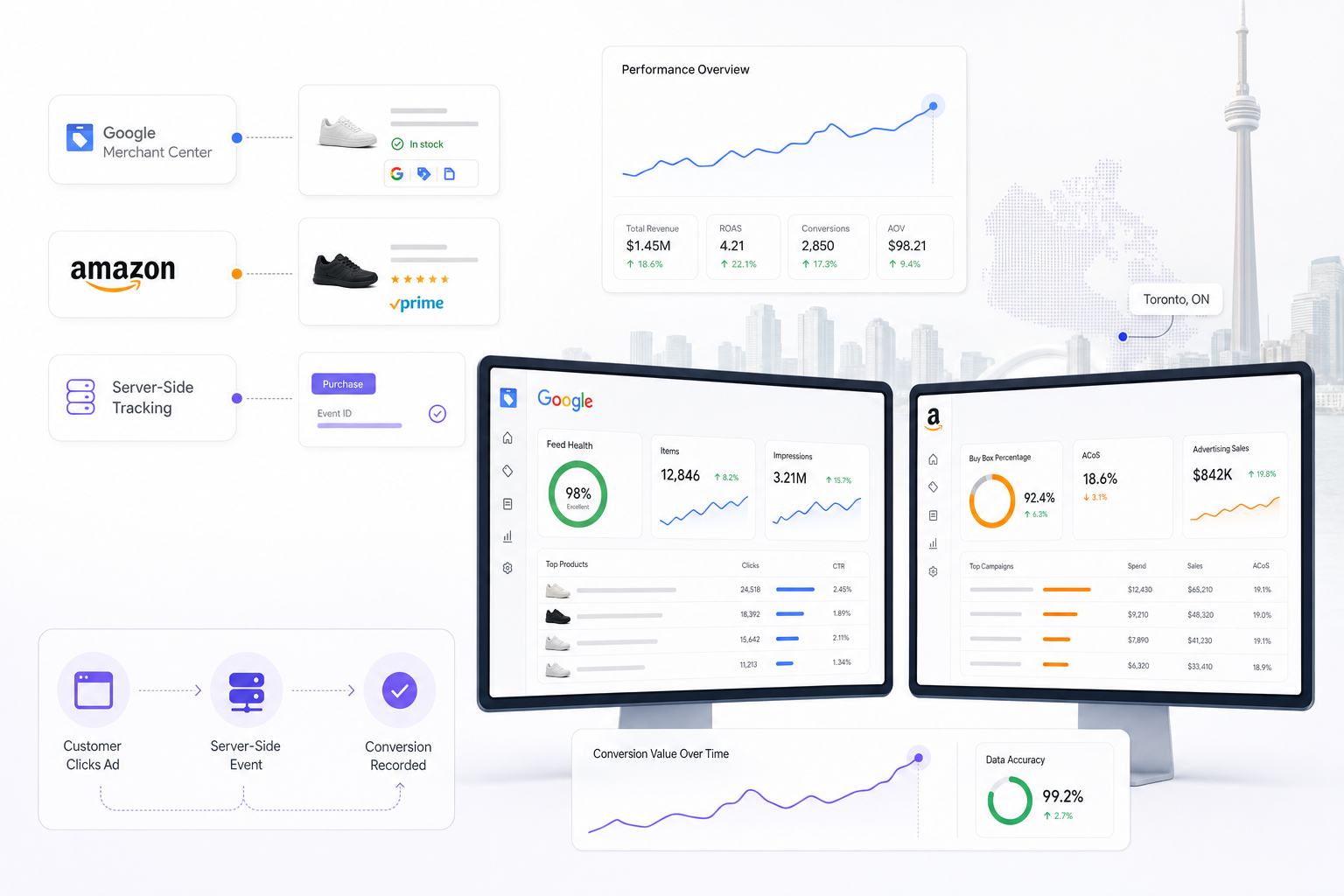
First up: server-side tracking. Browser-based tracking pixels are becoming unreliable. Ad blockers and privacy settings now wipe out half of your analytics data. Top-tier lead generation PPC agencies Toronto relies on set up server-side tagging in Google Tag Manager. They route events through custom subdomains to keep data accurate and reliable.
Second: Google Ads Enhanced Conversions for Leads. This is non-negotiable in 2026. When a user submits an inquiry, secure hashed first-party data (like their email or phone number) goes straight back to Google. This gives the bidding algorithm the missing pieces it needs to match conversions accurately across devices.
Third: offline conversion tracking and deep CRM loops. This is the real game-changer. Look at how an advanced CRM feedback loop operates:
- A prospect clicks an ad, carrying a unique Google Click ID (GCLID) or ValueTrack parameter.
- The user lands on your site, and that parameter gets stored in hidden form fields.
- The form syncs into HubSpot or Salesforce, attaching the click data directly to the lead record.
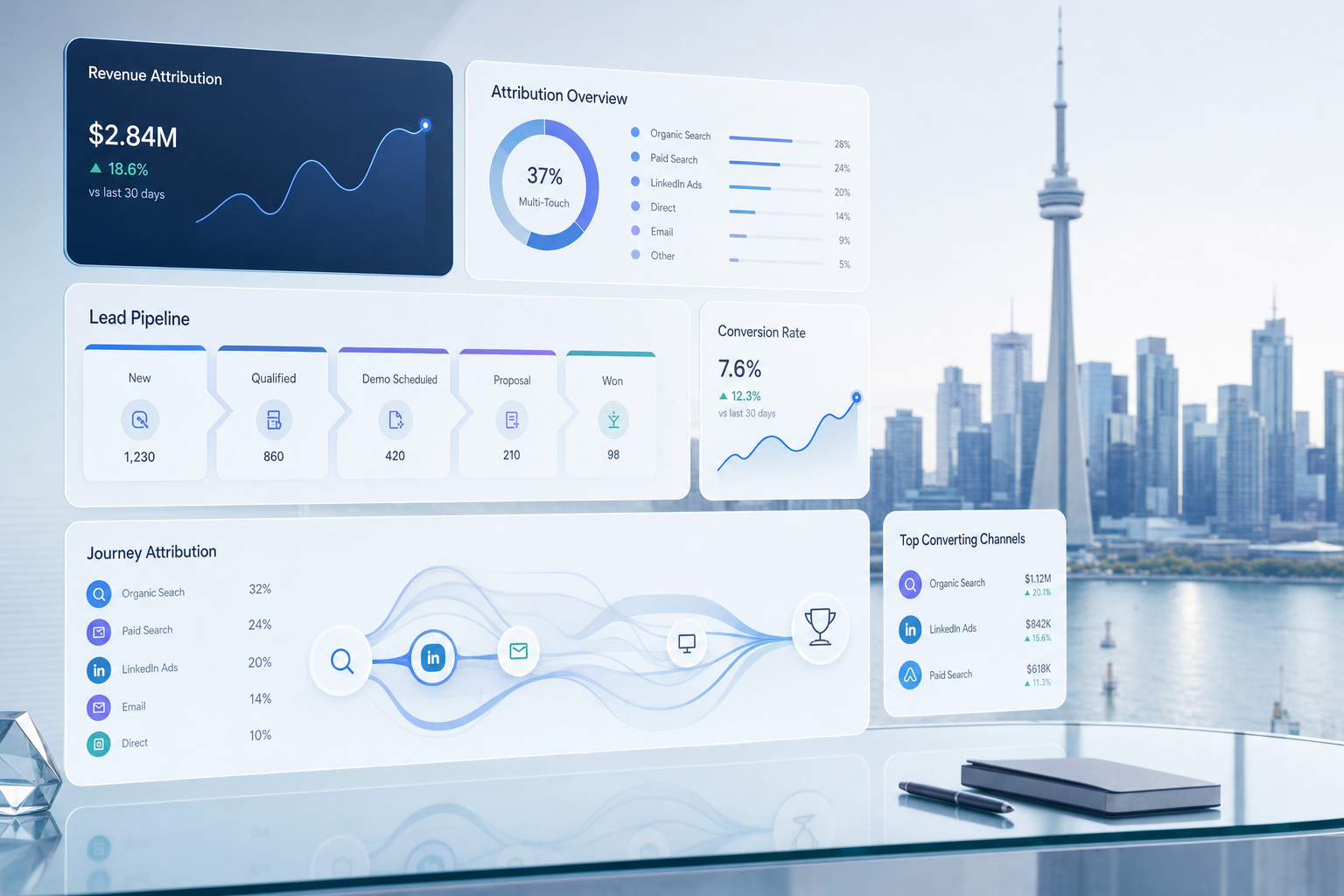
- Your sales team qualifies the lead, advances them to Sales Qualified Lead (SQL), and eventually marks the deal as Closed-Won.
- An automated integration shoots that stage change and deal value right back into Google Ads and LinkedIn Ads.
What does this accomplish? In simpler terms: it trains the ad network’s machine learning models to stop bidding on people who just download PDFs and start aggressively targeting prospects who match your closed-won customer profile. Bid algorithms stop chasing cheap spam because spam gets assigned a zero-dollar value in the CRM loop. That is how real lead generation works.
Evaluating Toronto Agencies: Clutch Standings vs. Operational Reality
So why Pipedrive then? Or Salesforce? Because data integrity matters. And the same rule applies when looking at local directories.
Hop onto Clutch, Google Maps, or agency directories, and you will see dozens of firms claiming to be the number one PPC agency in the Greater Toronto Area. But wait! High directory placement does not guarantee technical competence. Often, it just means the agency has a dedicated marketing coordinator gathering reviews or paying for featured sponsorship tiers.
When vetting top-performing PPC companies across Ontario and the broader North American market, you need to look past shiny badges. You have to evaluate operational reality:
- Who actually runs your campaigns? During the sales pitch, you meet seasoned partners and principal strategists. Two weeks later, your campaign gets handed off to a junior coordinator handling fifteen other client accounts simultaneously.
- Do they understand North American B2B market dynamics? A campaign targeting mid-market enterprises across Toronto, New York, and Chicago requires radically different positioning than a local residential service campaign.
- Do they treat Canadian privacy laws and US data protection seriously? Cross-border compliance between PIPEDA, provincial privacy mandates, and US regulations matters when capturing enterprise customer data.
- Can they showcase case studies with revenue outcomes? Ask to see pipeline growth, deal size impact, and closed revenue figures, not just inflated impression graphs.
A legitimate Toronto agency will have zero hesitation opening up anonymized campaign histories. If they get nervous when you ask about lead-to-opportunity conversion rates, you have your answer.
Core Metrics to Measure Beyond Cost Per Click (CPC)
If your agency reports stop at Cost Per Click (CPC) and standard Cost Per Lead (CPL), you are flying blind. Those metrics describe ad spend, not commercial health. To understand what is actually happening with your budget, track these four critical metrics instead:
- Cost Per Marketing Qualified Lead (CP-MQL): Total ad spend divided by leads that hit baseline criteria (verified company domain, matching target industry, realistic company size). If your CPL is $40 CAD but your CP-MQL is $400 CAD, nine out of ten leads are complete junk.
- Cost Per Sales Qualified Opportunity (CP-SQL): Total ad spend divided by prospects accepted by your sales team who enter an active pipeline stage. For mid-market B2B tech and service firms in Toronto, healthy benchmarks often hover between $800 and $2,500 CAD per SQL, depending on contract size.
- Lead-to-Opportunity Ratio: The percentage of initial form conversions that turn into active sales opportunities. If this drops below 15%, your ad targeting is off, your landing page is misleading visitors, or your qualification filters are broken.
- Customer Acquisition Cost (CAC) Payback Period: The months required for gross profit from a new customer to cover the total marketing and sales costs spent acquiring them. For sustainable scale, keep this under 12 months.
Crazy how everything was evaluated on basic clicks before, right? But modern revenue leaders cannot afford guesswork. Tracking pipeline metrics bridges the disconnect between marketing investment and sales success.
Questions to Expose Weak PPC Campaign Management
Ready to interview agencies? Do not ask generic questions like “What is your strategy for our brand?” They have canned answers ready to go. Instead, throw these technical curveballs during your discovery call:
- “How do you scrub spam submissions and bot traffic so our cost-per-lead reporting is not artificially deflated?” (Listen for honeypot form fields, reCAPTCHA v3 implementations, and custom exclusion filters—not just “we review search terms.”)
- “How do you configure Google Consent Mode v2 for our Canadian and international traffic?” (They should clearly explain how consent signals adjust tracking behavior without crashing conversion modeling.)
- “How frequently do you train bid algorithms on pipeline stage data instead of standard form fills?” (If they look confused, they only optimize for top-of-funnel conversion counts.)
- “Do we retain 100% administrative data ownership of our ad accounts, Google Tag Manager containers, and conversion tags?” (Never work with an agency that locks your data inside their proprietary accounts. Review standard PPC agency reporting transparency and data ownership standards before signing any contract.)
- “Who will be my primary point of contact, and will they be actively making optimizations in the ad account weekly?” (Ensure you are working directly with an experienced practitioner, not an account middleman.)
These questions cut straight through polished sales pitches. A seasoned team will lean in and answer enthusiastically. A surface-level agency will stumble through buzzwords.
Frequently Asked Questions
What is the typical management fee for lead generation PPC agencies in Toronto?
Toronto performance agencies typically charge between $2,500 and $7,500 CAD monthly as a flat retainer for small to mid-market programs. Larger accounts often work on an ad spend tier—usually 12% to 18% of monthly spend. Expect upfront setup or onboarding fees if the agency needs to overhaul your tracking infrastructure, configure server-side containers, or wire up direct CRM integrations.
How long does it take for a B2B PPC campaign to produce sales-qualified leads?
Initial form conversions usually land within the first two to four weeks as campaigns launch and initial keyword data starts coming in. But calibrated sales-qualified opportunities typically require 60 to 90 days. That testing period gives the agency enough time to harvest search term data, trim negative keywords, and feed offline CRM milestones back into the bidding algorithms.
Why is deep conversion tracking critical for B2B lead generation?
Standard tracking registers any form submission as a win, which incentivizes ad networks to hunt down users who click and submit forms easily. The problem? Those users are often bots, job seekers, and researchers. Deep conversion tracking passes lifecycle stages (MQL, SQL, Closed-Won) directly back into Google Ads and LinkedIn Ads. This trains the machine learning systems to bid aggressively on actual decision-makers who buy your product.