
In the competitive B2B landscape, particularly within industrial and tech sectors, generating truly qualified leads through paid advertising requires a strategic approach distinct from B2C campaigns. You know this. It’s not just about getting clicks; it’s about attracting the right businesses, the ones with a real need and a budget. This guide provides actionable B2B PPC strategies designed to help industrial and tech companies drive higher-value leads, optimize for longer sales cycles, and stand out in niche markets. Because let’s be honest, generic PPC advice just doesn’t cut it when you’re selling complex solutions, does it?
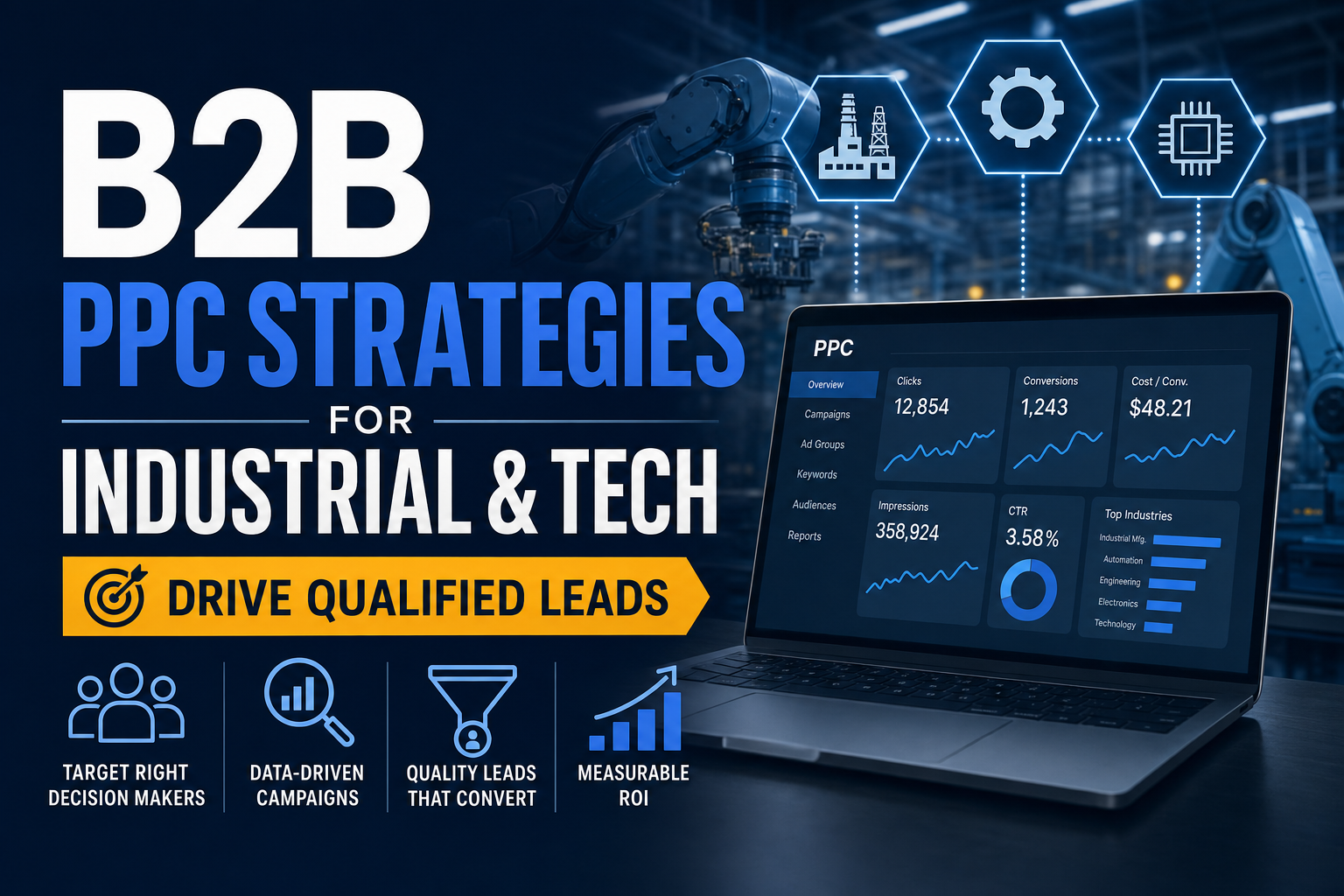
Understanding the B2B PPC Landscape: Beyond Clicks
Most people think hiring a PPC agency means someone logs into Google Ads, sets a budget, and watches the clicks roll in. That’s not how it works. Or at least, that’s not how it should work for B2B. When we talk about B2B PPC, we’re not chasing impulse buys. We’re targeting decision-makers, procurement teams, and engineers who are researching mission-critical solutions.
Think about it. A B2C campaign might aim for thousands of clicks at a low cost, hoping for a quick sale. But in B2B, especially in the industrial and tech sectors, a single lead can be worth tens of thousands, even millions, over its lifetime. So, quantity? Not our priority. Lead quality is everything. Your buyer’s journey isn’t a sprint; it’s a marathon, often involving multiple stakeholders and extensive due diligence.
This is huge because traditional PPC tactics, built for rapid B2C conversions, often fall short here. Broad keywords, generic ad copy, and simple landing pages? They’ll just burn through your budget with unqualified traffic. Instead, B2B PPC focuses on precision. We target specific intent, understand the intricate decision-making process, and nurture leads over a longer sales cycle. It’s a completely different ballgame, really.
Tailoring B2B PPC Strategies for Industrial & Tech Sectors
So, how do we make PPC truly work for complex industrial and tech businesses? It all starts with understanding your audience, then crafting your B2B PPC strategies to match their unique buying journey. Your buyers aren’t just consumers; they’re experts in their fields. They speak a technical language, and they expect you to speak it too.
First, audience segmentation is critical. Forget demographic targeting. Think firmographics: company size, industry, revenue, technology stack. Are you selling to a small manufacturing plant or a multinational aerospace firm? That dictates everything. And don’t forget job titles and decision-making authority. We want the engineers, the product managers, the CTOs – the people who understand the problem you solve and have the power to make a purchase. This goes hand in hand with effective B2B lead generation.
Then comes keyword research. For industrial sector marketing, this isn’t about “best widget.” It’s about “industrial automation software for discrete manufacturing,” “precision CNC machining services,” or “enterprise cybersecurity solutions for IoT devices.” Long-tail, highly specific keywords are your best friends here. They might have lower search volume, but the intent behind them is gold. Someone searching for a highly specific solution is much closer to a purchase than someone browsing general terms. Awesome, right?
Messaging also needs to resonate with technical buyers. Forget flashy slogans. They want data, specifications, ROI projections, and proof points. Speak to their pain points with clarity and authority. What specific problem does your product solve? How does it improve efficiency, reduce downtime, or increase output? And budget allocation? You’re playing the long game. Don’t expect instant conversions. Your budget needs to support multiple touchpoints across a longer conversion path, perhaps over several months. It’s an investment, more than most clients realise.
Key B2B PPC Strategies for Industrial & Tech Companies in 2026
Okay, let’s get into the nitty-gritty. What B2B PPC strategies actually deliver qualified leads for industrial and tech companies in 2026? It’s a blend of platforms and tactics, all working together to nurture those high-value prospects.
First up: Account-Based Marketing (ABM) PPC integration. This is huge because it allows you to target specific, high-value accounts you’ve already identified. Instead of casting a wide net, you’re using your paid ads to reach individuals within those target companies. Imagine serving custom ads to key decision-makers at your top 50 prospect accounts on LinkedIn or even through Google Display Network placements on industry-specific sites. That’s precision marketing, and it drives results.
Next, LinkedIn Ads. For professional targeting, nothing beats it. You can segment by job title, industry, company size, skills, and even specific groups. This means your ads for, say, advanced robotics components, are seen only by manufacturing engineers or production managers at relevant companies. The cost per click might be higher than Google, but the lead quality? Stellar.
Google Ads, of course, is still vital. But here’s the catch – you need to use it smartly. Focus on highly specific B2B intent keywords. Bid aggressively on terms that indicate immediate buying intent, like “buy industrial sensors online” or “ERP software for logistics companies pricing.” But don’t just stop there. Utilize Google’s Custom Intent audiences to target people who are actively researching competitors or complementary products. This is where you intercept buyers further down the funnel.
Remarketing is another non-negotiable strategy for nurturing. Most B2B buyers don’t convert on the first visit. They research, compare, and deliberate. Remarketing allows you to stay top-of-mind by showing relevant ads to people who have already interacted with your website or content. Did they download a whitepaper? Show them an ad for a product demo. Did they visit a specific product page? Follow up with a case study showcasing that product’s benefits. It keeps them engaged and moving towards conversion.
And then there’s content syndication via paid channels. Your valuable whitepapers, webinars, and technical guides aren’t just for organic traffic. Use platforms like LinkedIn, Facebook (with lookalike audiences based on your ideal customer profile), or even specialized B2B content networks to push your thought leadership to new audiences. This positions you as an expert and fills the top of your funnel with informed prospects.
Finally, data-driven optimization techniques tie it all together. Don’t just set it and forget it. A/B test ad copy, landing page variations, bidding strategies, and audience segments constantly. Look beyond simple clicks and conversions. Track lead quality, sales-qualified leads (SQLs), and even opportunities generated from PPC. Use CRM integration to see what happens after the click. This feedback loop is essential for refining your campaigns and ensuring every dollar delivers maximum ROI.
Crafting Compelling Ad Copy and Landing Pages for B2B
Even the best targeting falls flat without compelling ad copy and landing pages. In B2B, especially for industrial and tech, your ad needs to immediately convey value and speak to specific technical pain points. Think problem-solution. Your prospect isn’t looking for entertainment; they’re looking for answers.
For ad copy, be direct and benefit-oriented. Instead of “Innovative Widget Solutions,” try “Reduce Machine Downtime by 20% with Our Smart Sensors.” Use numbers. Use technical language when appropriate. Feature unique selling propositions that truly differentiate you. Highlight compliance or certifications if they matter to your audience. This isn’t about being catchy; it’s about being credible and relevant.
Now, landing pages. This is where many B2B campaigns falter. Your landing page isn’t just a brochure. It’s a conversion engine. It needs to continue the conversation started by your ad, reinforce your value proposition, and provide clear next steps. Crucially, it must feature elements that cater to a B2B buyer’s information needs. We’re talking case studies, detailed spec sheets, whitepapers, ROI calculators, or direct requests for a custom demo or consultation. Generic “contact us” forms often don’t cut it. You need to offer different conversion paths for different stages of the buyer’s journey.
And clear calls-to-action (CTAs)? Non-negotiable. “Download the Technical Spec Sheet,” “Request a Custom Demo,” “Get a Free Consultation,” or “See Our Case Studies” are far more effective than “Learn More.” Make it obvious what you want them to do, and make the process as frictionless as possible. That’s how you drive conversions.
Measuring B2B PPC Success: Beyond Vanity Metrics
Clicks and impressions? Those are vanity metrics in B2B. What truly matters is the impact on your bottom line. Measuring B2B PPC success requires a shift in focus to lead quality, cost per qualified lead (CPL), and customer lifetime value (CLV). This isn’t just about tracking what happens in your ad platform; it’s about connecting ad performance to actual business outcomes.
Here’s what most people don’t know: you need to integrate your CRM. Connecting your ad platforms to your CRM allows you to see the entire lead journey. Did that PPC lead turn into a sales opportunity? What was their value? How long did it take to close? This kind of data is gold for optimizing your campaigns.
Lead scoring is another critical piece. Not all leads are created equal, right? Implement a system to score leads based on their engagement, firmographics, and declared intent. This way, your sales team prioritizes the highest-quality leads generated by PPC. Multi-touch attribution models are also essential. B2B sales cycles involve many touchpoints, and PPC might be the first, middle, or last interaction. Understanding how PPC contributes across the entire funnel gives you a more accurate picture of its ROI. We talked about this implicitly in The 5-Step Framework for Tracking PPC ROI, where the full picture of customer interactions matters.
Key Performance Indicators (KPIs) for B2B should reflect this. Focus on metrics like MQL-to-SQL conversion rate, pipeline generated, and closed-won revenue from PPC. These KPIs align your PPC efforts directly with your sales objectives, ensuring your advertising spend is truly driving growth. It’s about seeing the full journey, not just the starting line.
Why Choose a Specialized B2B Digital Marketing Agency?
Navigating the nuances of B2B PPC strategies in industrial and tech sectors is no small feat. It’s why many companies, especially those with complex offerings, find immense value in partnering with specialized B2B digital marketing agencies. Here’s why that expertise makes all the difference.
Specialized agencies like Umbrella, a performance marketing agency, possess industry-specific knowledge. We don’t just understand PPC; we understand manufacturing, engineering, SaaS, and cutting-edge technology. This means we speak your language, grasp your product complexities, and identify with your target buyers more quickly. It saves you time and ensures campaigns are relevant from day one. You’re not teaching us your business; we already get it.
We also understand complex sales cycles. We know that a tech buyer needs different information than an industrial buyer, and both require more nurturing than a B2C consumer. Our strategies account for these longer conversion paths, implementing multi-stage funnels and sophisticated remarketing to keep prospects engaged until they’re ready to buy. We’re not just running ads; we’re building a pipeline.
Furthermore, an experienced agency brings a wealth of data and best practices from working with similar clients. We’ve seen what works and what doesn’t. This allows us to develop targeted B2B PPC strategies more effectively, avoiding common pitfalls and accelerating your path to qualified leads. We offer integrated digital marketing solutions, meaning your PPC isn’t operating in a silo. It works with your SEO, content, and overall marketing efforts. That kind of holistic approach is invaluable, helping you gain a crucial competitive advantage in niche markets.
Common B2B PPC Pitfalls to Avoid
Even with a solid plan, B2B PPC campaigns can stumble. Knowing the common pitfalls helps you steer clear of them. Because nobody wants to waste budget, right?
One major issue is broad targeting. Trying to reach “everyone” means you reach no one specific enough to convert. You’ll just get irrelevant clicks and frustrated sales teams. The solution? Hyper-focus your audience. Segment, segment, segment.
Another pitfall: generic messaging. If your ad copy and landing page content don’t speak directly to a B2B buyer’s technical needs or pain points, they’ll bounce. Fast. Make your messaging precise, benefit-driven, and technical when necessary. Show them you understand their world.
Then there’s the poor landing page experience. You’ve gotten the click; don’t lose the lead with a slow, confusing, or irrelevant landing page. Ensure it loads quickly, is mobile-friendly, and provides the exact information or offer your ad promised.
Neglecting remarketing is also a big mistake. B2B buyers almost never convert on their first visit. If you’re not re-engaging them with targeted ads, you’re leaving money on the table. It’s a fundamental part of the nurturing process.
And finally, misinterpreting metrics. Focusing solely on clicks and impressions without linking them to lead quality or sales revenue is a recipe for disaster. Track the right KPIs – CPL, MQL-to-SQL rate, and pipeline value – to understand true campaign effectiveness. Don’t chase vanity; chase value.
FAQs on B2B PPC Strategies
What are the main types of B2B marketing strategies?
B2B marketing involves a range of strategies, and PPC is a core part of many. You’ve got content marketing for thought leadership, email marketing for nurturing leads, social media marketing (especially LinkedIn for B2B), SEO for organic visibility, and events for networking. PPC strategies, using platforms like Google Ads and LinkedIn Ads, integrate with all of these. They drive immediate traffic, promote your content, and capture intent that other channels might miss.
What is the 95/5 rule for B2B?
The 95/5 rule in B2B says that at any given time, only about 5% of your target market is actively in-market and ready to buy. The other 95% aren’t buying immediately; they’re in a research or awareness phase. But why does this matter for PPC? It means your B2B PPC strategies need to account for this longer nurturing cycle. You’re not just targeting that 5%; you’re also building brand awareness and providing valuable content to the 95% who will eventually become buyers. Your PPC needs multiple touchpoints across the entire funnel, not just the bottom.
What does a B2B PPC strategy entail?
A B2B PPC strategy is a detailed plan for using paid advertising channels – like Google Ads, LinkedIn Ads, or even display networks – to reach specific business audiences. It’s designed to generate qualified leads and ultimately drive conversions, recognizing the longer sales cycles and higher customer value inherent in B2B. This means highly targeted keyword research, audience segmentation, compelling ad copy, optimized landing pages, precise bidding strategies, and robust tracking to measure ROI beyond just clicks. It’s all about getting the right message, to the right person, at the right time.
What are some effective B2B marketing strategies?
Effective B2B marketing strategies are all about reaching decision-makers with relevant value. This includes robust content marketing (think whitepapers, case studies, webinars), Account-Based Marketing (ABM) for high-value targets, strong SEO to capture organic search intent, and targeted email marketing campaigns. Critically, highly effective B2B PPC strategies play a central role. They provide immediate visibility, capture high-intent buyers, and can accelerate lead generation when integrated properly with your other digital marketing efforts. It’s a multi-pronged approach, but PPC often kicks things into high gear.